
Programming Basic
C++ What is OOP?
OOP stands for Object-Oriented Programming. Procedural programming is about writing procedures or functions that perform operations on the data, while object-oriented programming is about creating objects that contain both data and functions.
Object-oriented programming has several advantages over procedural programming:
- OOP is faster and easier to execute
- OOP provides a clear structure for the programs
- OOP helps to keep the C++ code DRY “Don’t Repeat Yourself”, and makes the code easier to maintain, modify and debug
- OOP makes it possible to create full reusable applications with less code and shorter development time
Tip: The “Don’t Repeat Yourself” (DRY) principle is about reducing the repetition of code. You should extract out the codes that are common for the application, and place them at a single place and reuse them instead of repeating it.
C++ What are Classes and Objects?
Classes and objects are the two main aspects of object-oriented programming.Look at the following illustration to see the difference between class and objects:
classFruit
| objectsApple Banana Mango
|
Another example:classCar
| objectsVolvo Audi Toyota
|
So, a class is a template for objects, and an object is an instance of a class.
When the individual objects are created, they inherit all the variables and functions from the class.
C++ Classes/Objects
C++ is an object-oriented programming language.
Everything in C++ is associated with classes and objects, along with its attributes and methods. For example: in real life, a car is an object. The car has attributes, such as weight and color, and methods, such as drive and brake.
Attributes and methods are basically variables and functions that belongs to the class. These are often referred to as “class members”.
A class is a user-defined data type that we can use in our program, and it works as an object constructor, or a “blueprint” for creating objects.
Create a Class
To create a class, use the class keyword:
Example
Create a class called “MyClass”:
class MyClass { // The class
public: // Access specifier
int myNum; // Attribute (int variable)
string myString; // Attribute (string variable)
};
Example explained
- The class keyword is used to create a class called MyClass.
- The public keyword is an access specifier, which specifies that members (attributes and methods) of the class are accessible from outside the class. You will learn more about access specifiers later.
- Inside the class, there is an integer variable myNum and a string variable myString. When variables are declared within a class, they are called attributes.
- At last, end the class definition with a semicolon ; .
- Object-oriented programming – As the name suggests uses objects in programming. Object-oriented programming aims to implement real-world entities like inheritance, hiding, polymorphism, etc in programming. The main aim of OOP is to bind together the data and the functions that operate on them so that no other part of the code can access this data except that function.
Characteristics of an Object Oriented Programming language
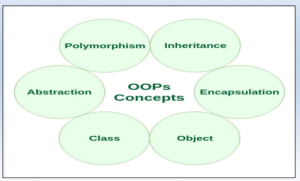
Class: The building block of C++ that leads to Object-Oriented programming is a Class. It is a user-defined data type, which holds its own data members and member functions, which can be accessed and used by creating an instance of that class. A class is like a blueprint for an object.
For Example: Consider the Class of Cars. There may be many cars with different names and brand but all of them will share some common properties like all of them will have 4 wheels, Speed Limit, Mileage range etc. So here, Car is the class and wheels, speed limits, mileage are their properties.
- A Class is a user-defined data-type which has data members and member functions.
- Data members are the data variables and member functions are the functions used to manipulate these variables and together these data members and member functions define the properties and behaviour of the objects in a Class.
- In the above example of class Car, the data member will be speed limit, mileage etc and member functions can apply brakes, increase speed etc.
We can say that a Class in C++ is a blue-print representing a group of objects which shares some common properties and behaviours.
Object: An Object is an identifiable entity with some characteristics and behaviour. An Object is an instance of a Class. When a class is defined, no memory is allocated but when it is instantiated (i.e. an object is created) memory is allocated.
| class person { char name[20]; int id; public: void getdetails(){} }; int main() { person p1; // p1 is a object } |
Object take up space in memory and have an associated address like a record in pascal or structure or union in C.
When a program is executed the objects interact by sending messages to one another.Each object contains data and code to manipulate the data. Objects can interact without having to know details of each other’s data or code, it is sufficient to know the type of message accepted and type of response returned by the objects.
